Explanation: What created the internal second ring of this double ringed basin on Mercury? No one is sure. The unusual feature spans 160 kilometers and was imaged during the robotic MESSENGER spacecraft's swing past our Solar System's innermost planet last week. Double and multiple ringed basins, although rare, have also been imaged in years past on Mars, Venus, Earth, and Earth's Moon. Mercury itself has several doubles, including huge Caloris basin, Rembrandt basin, and enigmatic Raditladi basin. Most large circular features on planets and moons are caused initially by a forceful impact by a single asteroid or comet fragment. Since it is unlikely that a second impact would occur right in the center of the first, large double rings are usually attributed to a subsequent volcanic lava flow inside the impact crater. Possibly, though, a second ring could be caused by the melting and flowing of material upon impact. One clue to the origin of the above-imaged double ring is that the basin center appears much smoother than the region between the rings. MESSENGER has now completed its last flyby of Mercury but will return and attempt to enter orbit in 2011 March.
Wednesday, October 7, 2009
A Double Ringed Basin on Mercury
Explanation: What created the internal second ring of this double ringed basin on Mercury? No one is sure. The unusual feature spans 160 kilometers and was imaged during the robotic MESSENGER spacecraft's swing past our Solar System's innermost planet last week. Double and multiple ringed basins, although rare, have also been imaged in years past on Mars, Venus, Earth, and Earth's Moon. Mercury itself has several doubles, including huge Caloris basin, Rembrandt basin, and enigmatic Raditladi basin. Most large circular features on planets and moons are caused initially by a forceful impact by a single asteroid or comet fragment. Since it is unlikely that a second impact would occur right in the center of the first, large double rings are usually attributed to a subsequent volcanic lava flow inside the impact crater. Possibly, though, a second ring could be caused by the melting and flowing of material upon impact. One clue to the origin of the above-imaged double ring is that the basin center appears much smoother than the region between the rings. MESSENGER has now completed its last flyby of Mercury but will return and attempt to enter orbit in 2011 March.

Monday, October 5, 2009
The Lagoon Nebula from GigaGalaxy Zoom
 Explanation: The large majestic Lagoon Nebula is home for many young stars and hot gas. Spanning 100 light years across while lying only about 5000 light years distant, the Lagoon Nebulae is so big and bright that it can be seen without a telescope toward the constellation of Sagittarius. Many bright stars are visible from NGC 6530, an open cluster that formed in the nebula only several million years ago. The greater nebula, also known as M8 and NGC 6523, is named "Lagoon" for the band of dust seen to the left of the open cluster's center. A bright knot of gas and dust in the nebula's center is known as the Hourglass Nebula. The above picture is a newly released, digitally stitched panorama of M8 taken as part of the GigaGalaxy Zoom project by the Wide Field Imager attached to the MPG/ESO 2.2-meter Telescope at the La Silla Observatory in Chile. The vista spans three times the diameter of the Moon, while the highest resolution image version occupies over 350 million pixels. Star formation continues in the Lagoon Nebula as witnessed by the many globules that exist there.
The International Space Station Over Earth
 Explanation: After undocking, the space shuttle Discovery crew got a memorable view of the developing International Space Station (ISS). Pictured orbiting high above Earth last month, numerous solar panels, trusses, and science modules of the ISS were visible. The Discovery crew brought mission specialist Nicole Stott to the ISS, and returned astronaut Timothy Kopra to Earth. Among the many mission and expedition accomplishments of the Discovery crew included delivering and placing the Fluids Integrated Rack and the Materials Science Research Rack in the Destiny module as well as the Minus Eighty Degree Laboratory Freezer in the Kibo module. Better known, however, was the delivery of the COLBERT treadmill for keeping astronauts fit. Over this past week the Soyuz TMA-16 spacecraft carrying three more astronauts docked with the ISS as Expedition 21 is set to begin. The next shuttle trip to the ISS is currently scheduled for 2009 November 12.
Sunday, October 4, 2009
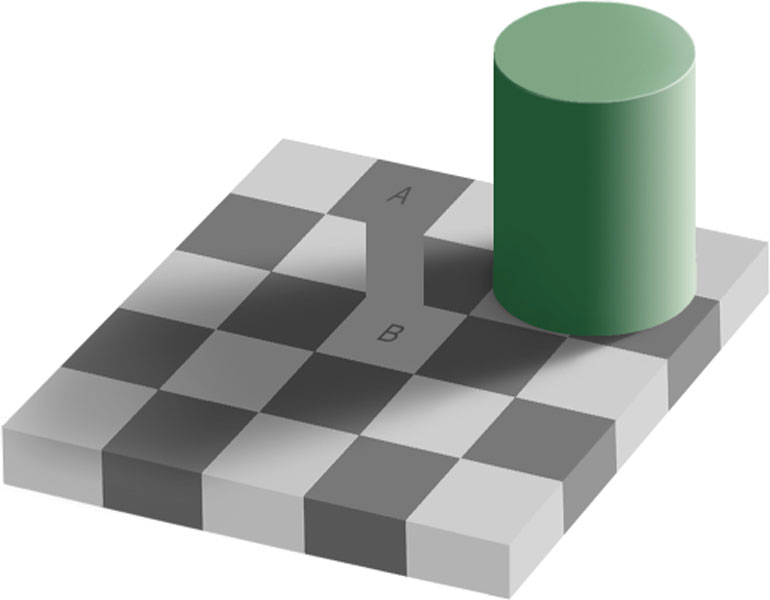
The Same Color Illusion

Explanation: Are square A and B the same color? They are. Are too. To verify this, click here to see them connected. The above illusion, called the same color illusion, illustrates that purely human observations in science may be ambiguous or inaccurate. Even such a seemingly direct perception as relative color. Similar illusions exist on the sky, such as the size of the Moon near the horizon, or the apparent shapes of astronomical objects. The advent of automated, reproducible, measuring devices such as CCDs have made science in general and astronomy in particular less prone to, but not free of, human-biased illusions.
Saturday, October 3, 2009
Old Faith-Full Moon

Explanation: Scheduled to illuminate the landscape throughout the night tomorrow, October's bright Full Moon will also be called the Harvest Moon. Traditionally, the Harvest Moon is the Full Moon closest to the autumnal equinox. But in this vacation snapshot, the Full Moon could be called the "Old Faith-Full Moon". Taken on September 4, the picture combines the regularly occurring lunar phase with Old Faithful Geyser in Yellowstone National Park, named for its dependable erruptions. Shining on the well-known geyser's towering pillar from behind, the moonlight creates an eerie halo surrounding convoluted shapes. Faithfully, the Full Moon itself is bright enough to be seen through the dense swirling steam near the top.
Friday, October 2, 2009
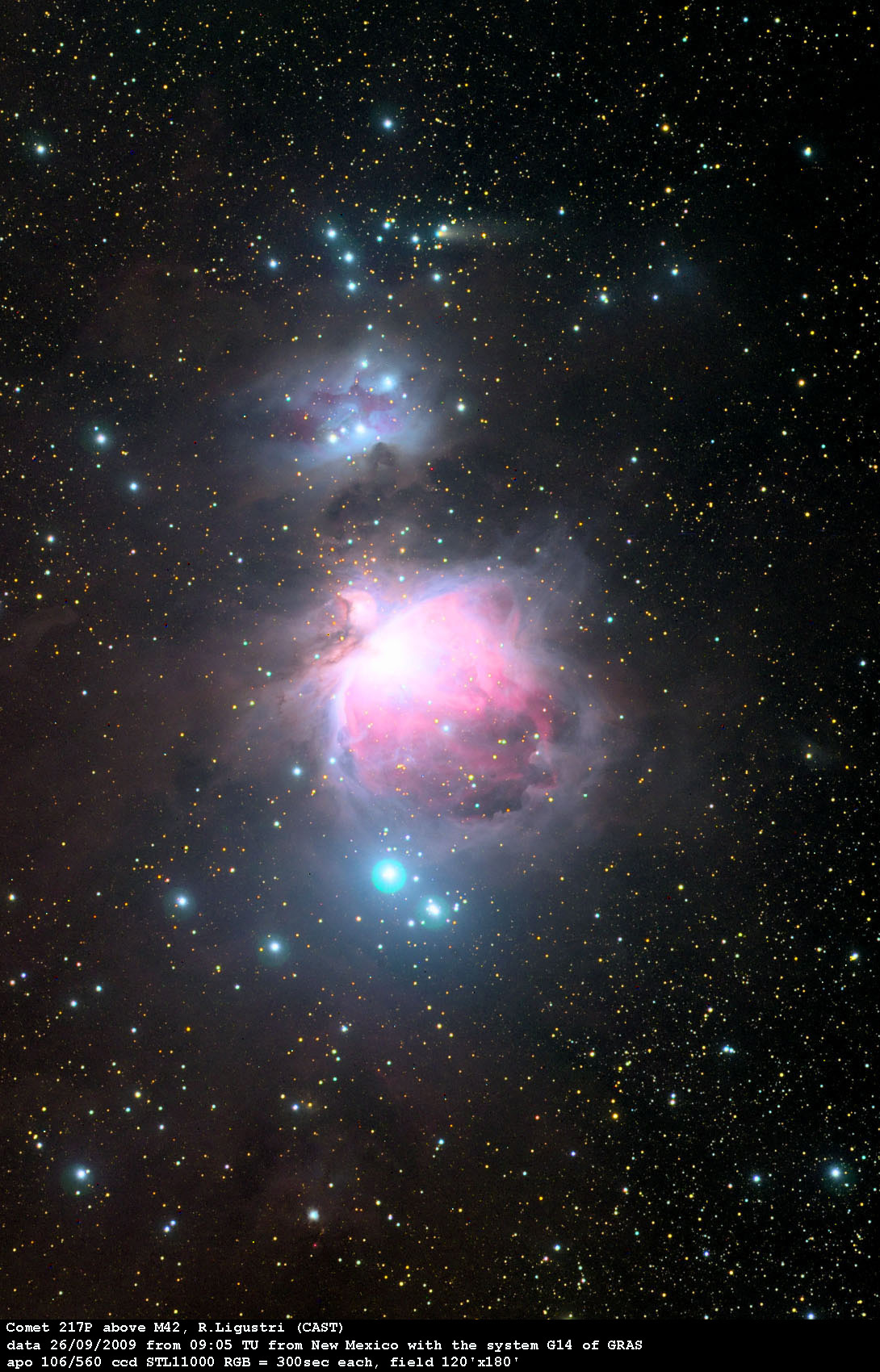
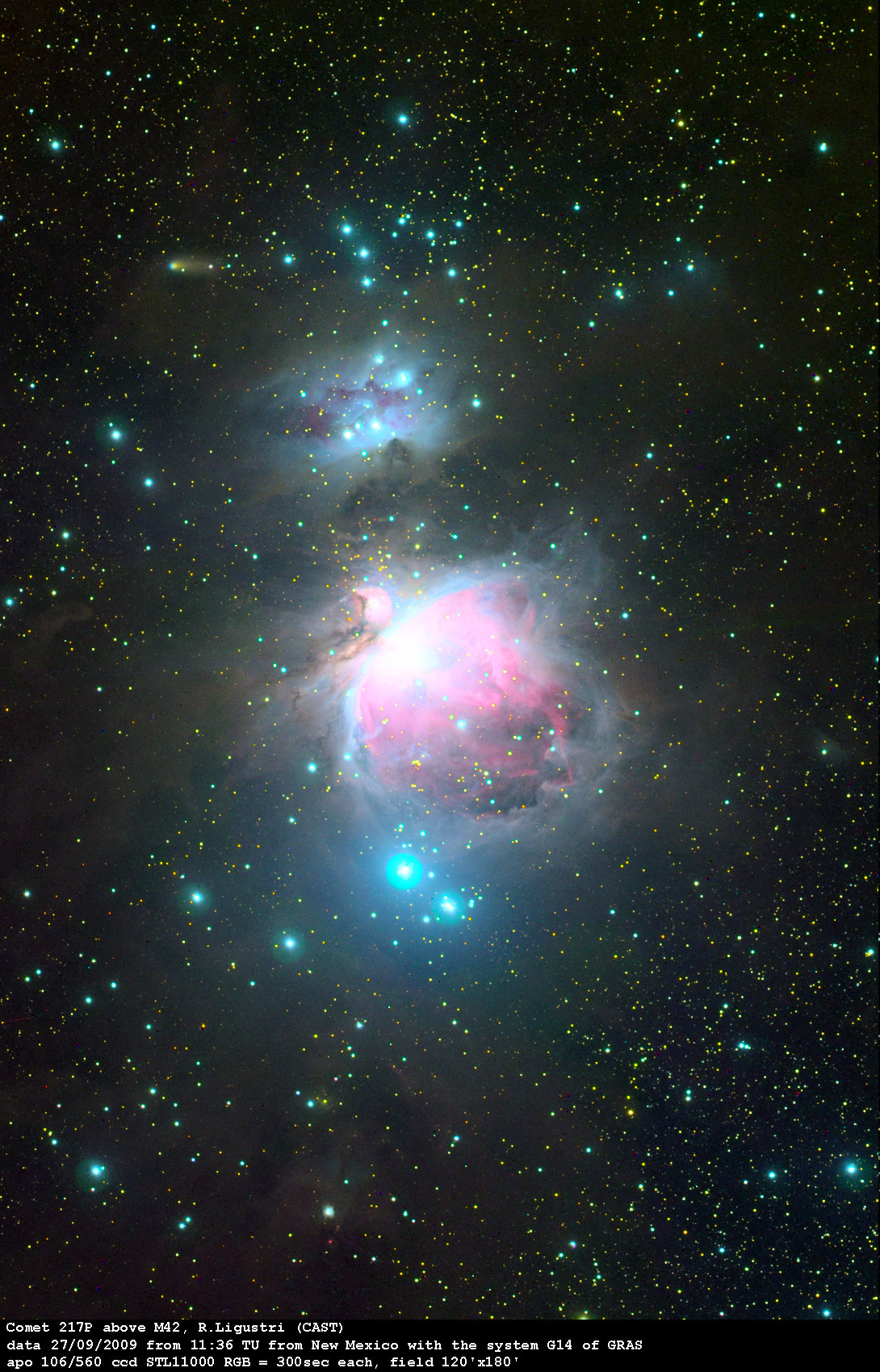
Comet and Orion

Explanation: These colorful panels both feature a familiar northern hemisphere astronomical sight: the stellar nursery known as the Great Orion Nebula. They also offer an intriguing and unfamiliar detail of the nebula rich skyscape -- a passing comet. Recorded this weekend with a remotely operated telescope in New Mexico, the right hand image was taken on September 26 and the left on September 27. Comet 217P Linear sports an extended greenish tail and lies above the bluish Running Man reflection nebula near the top of both frames. Nearby and moving rapidly through the night sky, the comet's position clearly shifts against the cosmic nebulae and background stars from one night to the next. In fact, the comet was a mere 5 light-minutes away on September 27, compared to 1,500 light-years for the Orion Nebula. Much too faint to be seen with the unaided eye, Comet 217P Linear is a small periodic comet with an orbital period of about 8 years. At its most distant point from the Sun, the comet's orbit is calculated to reach beyond the orbit of Jupiter At its closest point to the Sun, the comet still lies just beyond the orbit of planet Earth.
Thursday, October 1, 2009
Carina Pillar and Jets

Explanation: This cosmic pillar of gas and dust is nearly 2 light-years wide. The structure lies within one of our galaxy's largest star forming regions, the Carina Nebula, shining in southern skies at a distance of about 7,500 light-years. The pillar's convoluted outlines are shaped by the winds and radiation of Carina's young, hot, massive stars. But the interior of the cosmic pillar itself is home to stars in the process of formation. In fact, placing your cursor over this visible light image will reveal a penetrating near-infrared view of pillar - now dominated by two, narrow, energetic jets blasting outward from a still hidden infant star. Both visible light and near-infrared images were made using the Hubble Space Telescope's newly installed Wide Field Camera 3.
Subscribe to:
Posts (Atom)